
Jonathan Garner, chief Asia and emerging markets equity strategist, Morgan Stanley, gives Samie Modak his assessment of the Indian economy after 3 years of Modi Sarkar.

India will see a three-fold jump in GDP.

When the country is full of confidence and resolve, and intellectuals of the world are optimistic about India, talk of pessimism, showing the country in poor light and hurting the morale of the country also takes place, he said at the India Today Conclave.

India Inc's investment project announcement falls to Rs 11.3 trillion. In the coming months, the pace of investments would depend on how soon consumption demand picks up and private sector investment ramps up investment in infrastructure.

Key macroeconomic indicators suggest softening industrial growth.
Consumer spending and the sentiment that guides it are the key to the growth of any market economy.

There has been a distinct trend change in the micro-indicators like rising auto sales and consumer confidence index in the last 20 quarters, Chandrasekaran stated.

Equity markets rallied after softer-than-expected inflation data in the US and UK rekindled hopes of the end of the rate-hiking cycle by major central banks. The soft inflation reading drove down bond yields and the US dollar, whetting the appetite for risky assets. The 10-year US bond yield fell below 4.5 per cent after topping 5 per cent less than a month ago.

Ashok Vaswani, a banker with more than three-and-half decades experience in building and scaling up businesses across consumer and corporate banking and payments, will be the next managing director (MD) and chief executive officer (CEO) of Kotak Mahindra Bank. Last week, the Reserve Bank of India (RBI) had given its approval to Vaswani's appointment. Vaswani is currently President of Pagaya Technologies, a US-Israeli artificial intelligence (AI) fintech firm, which he joined in June 2022.

This is reflected in an improvement in their sentiments as well, explains Mahesh Vyas.

Prime Minister Narendra Modi on Thursday suggested the G20 trade ministers to work collectively to ensure equitable competition between large and small sellers as there are challenges in the fast growing cross-border e-commerce. In a video message at the G20 Trade and Investment Minister's meeting here, he also emphasised on the need to address the problems faced by consumers in fair price discovery and grievance handling mechanisms. "Digitising processes and use of e-commerce have the potential to enhance market access. "I am glad that your group is working on the 'High Level Principles for the Digitalization of Trade Documents'. These principles can help countries in implementing cross-border electronic trade measures, and reduce compliance burdens.

Costlier vegetables slowly pushed retail inflation, which had remained well within the Reserve Bank's comfortable level of 4 per cent during most part of 2019, peaked to more than three-year high of 5.54 per cent in November.

The combined net profit of "early bird" companies, those that have declared their quarterly results, rose for the third consecutive quarter in July-September 2023 (Q2FY24). But the figures suggest a continued slowdown in revenue growth and stagnation in earnings over recent quarters. This slowdown is severe for companies in the manufacturing and non-financial service sectors.

About 56 million Indians may have plunged into extreme poverty in 2020 as a result of the pandemic, increasing the global tally by 71 million and making it the worst year for poverty reduction since World War II, according to fresh estimates by the World Bank. "The global goal of ending extreme poverty by 2030 is likely to be missed: By then, about 600 million people will remain in abject poverty. A major course correction is needed," Indermit Gill, chief economist at the World Bank, tweeted. The World Bank in its latest "Poverty and Shared Prosperity" made fresh estimates of poverty using a new extreme poverty line based on the purchasing power parity (PPP) of $2.15, the earlier one being at $1.9.

'I think some of us, like Mukesh Ambani, myself and those of us who head industrial units, ought to really focus on what we can really do to make the world a safer place, maybe 50 or 100 years from now.' 'For instance, how can we deal with climate change and global warming, right now?' 'The effects of it may not be felt now; in fact, we may pay a price for it today, but it will help the generations to follow.'

'At this stage, you should distribute money and food.' 'Like you queue up to vote, let people queue up to collect this.' 'This will arrest the decline in demand which will have a multiplier effect on the demand side for the economy as a whole.' 'The government should earmark about 2% of the GDP for this.' 'And this should be the first step to revive the economy.'

Even if no statistical jugglery is afoot, only to warn that the 'noise' in the numbers should be eliminated in order to hear the underlying music, without distortion, warns T N Ninan.

'Valuations of midcaps and smallcaps have reached very high levels, and hence to that extent leave little margin of safety.'

'As the Indian economy continues to expand over the next three years, mid- and small-caps should do well as they have higher exposure to the domestic economy than large-caps.'

The economy segment of India's car market is unlikely to revive soon term as inflation and prices prompt buyers to defer purchases. The share of entry-level cars in the passenger vehicle market dropped to the lowest in seven years at the end of the Financial Year 2021-22 (FY22). A recovery in the segment will be largely driven by the overall economic growth, improvement in income levels, and easing of semiconductor shortage, say carmakers and analysts.
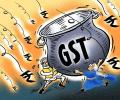
GST collections jumped 15 per cent to nearly Rs 1.68 lakh crore in November, the finance ministry said on Friday. Goods and Services Tax (GST) mop-up was over Rs 1.45 lakh crore in November 2022.

Change will have to begin with Mr Modi, who by all accounts has shown little active interest in macro-economic issues, preferring instead to focus on the effective implementation of projects and programmes, points out T N Ninan.

The Indian economy is likely to post better than anticipated growth in the second quarter (July-September) owing to robust urban consumption and expansion in services, a Business Standard analysis of high-frequency indicators showed. While gross domestic product growth in the September quarter is expected to come below the 7.8 per cent print in the June quarter due to a favourable base fading, analysts say the print will be much closer to 7 per cent than the 6.5 per cent anticipated earlier. While the Reserve Bank of India (RBI) had estimated 6.5 per cent growth for July-September, last month Governor Shaktikanta Das said the growth figure would surprise on the upside.

Now that the economy is growing at a higher-than-expected rate, it is time to accelerate the pace of fiscal consolidation, and the Budget could be a good starting point, argues Rajesh Kumar.

Economy showing mixed signals, outlook challenging: FinMin

Technically speaking, US equities have seen net losses since January. India is strongly influenced by US trends.

Packaged tea consumption in India has been under pressure due to inflation across the consumption basket coupled with higher tea prices. This is forcing tea drinkers to downtrade, especially in rural areas. Milk prices have also gone up and this has impacted tea consumption along with delayed winters in the north, companies have said. NIQ (formerly known as NielsenIQ) data shows that the packaged tea category grew around 4 per cent in value and volume terms in 2022 compared to 2021.

Debit card payments remained sluggish due to the surge in digital transactions after the pandemic, and the Unified Payments Interface (UPI) has emerged as the most popular mode of money transfer, particularly for small value transactions, according to RBI data. In July 2020, the total debit card spends stood at Rs 2.81 trillion, as compared to Rs 3.15 trillion in July 2023, reflecting a growth of 11.96 per cent. UPI spends have seen a whopping growth of 428 per cent, zooming from Rs 2.90 trillion to Rs 15.33 trillion during the same period, the data revealed.

The boom in organised retail will set the tone for major economic overhaul. The ripple effect will be improved supply chains, volume output, integration into global commerce, and higher tax collection, notes T N Ninan.

The combination of sanctions, and low fuel prices is really hurting the Putin regime.

'Given all the linkages, the monthly registration data for new vehicles, may well be the single most accurate indicator of India's economic health,' points out Devangshu Datta.


With rest of the world showing no signs of growth and headwinds ahead for US growth, chances are that we might continue to see central banks pumping money into their economies

According to a communication by the ministry to the heads of PSBs, it will be a bottom-up consultative process from the branch level onwards which will involve discussions at the branch or regional level, state level and national level.

From middle-class it is middle-income India, marketers are chasing for volumes. The 166 million households in this category is the new focus.

Inflation has seen some moderation in the recent past, falling from double-digit figures in 2013 to 7.8 per cent year-on-year in August.

Taking a strong view of Google pulling out some apps from its Play Store, the government on Saturday said delisting of Indian apps cannot be permitted and that the tech company and the startups concerned have been called for a meeting next week. In an interview to PTI, IT and Telecom Minister Ashwini Vaishnaw said the startup ecosystem is key to the Indian economy and their fate cannot be left to any big tech to decide. The minister's comments assume significance as Google on Friday began removing some apps, including popular matrimony apps, from its Play Store in India over a dispute on service fee payments, even as apps and well-known startup founders cried foul.

Bihar has fertile grounds for caste to emerge as an electoral issue.

Fresh investments are constrained by tepid demand.

The biggest bounce is in the realty sector, where the industry index jumped 80%. There's been a turnaround also in automobiles and ancillaries (up 45%). The pharma and health care indices have a welcome return of roughly 35%.
